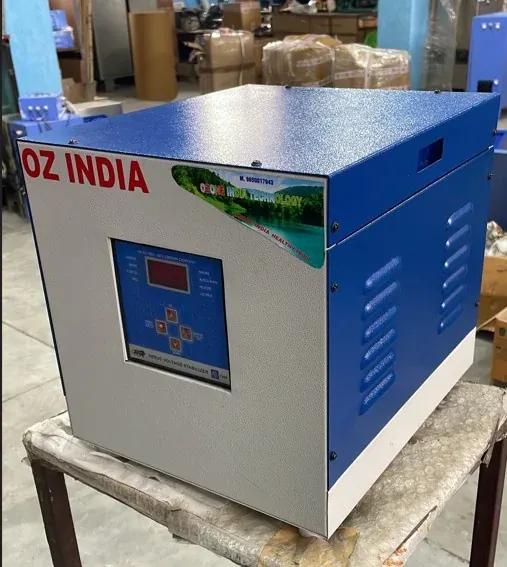
The Servo Voltage Stabilizer is deployed across a diverse set of Indian industrial and commercial contexts. What follows is a set of expert application briefs prepared by our engineering team, each describing the operating problem, the applicable Indian and international standards, and how Ozmist's configuration is engineered to meet it.
Every application description references peer-reviewed research or a named regulatory standard so procurement teams, quality engineers, and plant managers can validate the claims against their own audit expectations. Sources are cited in the References section at the end of this page. If your application does not match one of the profiles below, contact our engineering team via the quote form — the majority of custom Ozmist installations begin with a spec conversation rather than a datasheet pick.
CNC Machines and Precision Machining Centres
CNC / precision engineering · CEA voltage supply norms; IEC 61000-4-11
CNC servo drives, spindle controllers, and PLC electronics are highly sensitive to voltage variations. A 15% voltage sag can trigger servo-fault shutdowns; sustained undervoltage burns spindle motor windings; overvoltage damages drive electronics. Indian industrial voltage in Tier-2 and Tier-3 city clusters commonly varies ±15–20% during peak load hours, causing repeated CNC downtime. A properly-sized servo stabilizer eliminates voltage-caused shutdowns and extends drive and motor life. Ozmist supplies CNC installations across the auto-component and general engineering clusters in Faridabad, Ghaziabad, Manesar, and Pune with 20–100 kVA three-phase stabilizers.
Medical Diagnostic Imaging Equipment
Healthcare / diagnostics · AERB X-ray Installation; IEC 60601-1
MRI, CT, digital X-ray, and ultrasound systems specify tight input voltage tolerances (±5% typical). Grid voltage in Indian hospitals varies far beyond this. Servo stabilizers of 30–100 kVA capacity are standard in Indian diagnostic centres and multi-specialty hospitals. Ozmist supplies medical-grade stabilizers with lower audible noise (< 55 dB(A)), soft-start to avoid tripping upstream UPS/generator, and dust-tight enclosures for radiology-room installation. Compliance to Atomic Energy Regulatory Board (AERB) X-ray installation guidelines is supported through the Ozmist documentation set.
Laboratory Instruments and Analytical Equipment
Analytical laboratories
HPLC, GC-MS, spectrophotometers, and other analytical instruments give unreliable results under voltage fluctuation. Chromatography column temperature stability, detector sensitivity, and pump flow uniformity all depend on stable line voltage. Ozmist supplies pharma QC labs, academic research groups, and BIS testing houses with 3–10 kVA single-phase stabilizers, often mounted below the instrument bench for space efficiency.
Textile Weaving and Knitting Machines
Textile manufacturing
Modern electronic looms, circular knitting machines, and warp-knitting machines are increasingly voltage-sensitive. Historical mechanical looms tolerated wide voltage; modern rapier and air-jet looms with servo weft insertion require tight regulation. Ozmist supplies textile mills in Panipat, Meerut, Ludhiana, and Surat with 25–200 kVA three-phase stabilizers, often with unbalanced-input correction for the persistent phase-voltage imbalance in industrial textile clusters.
Food and Pharmaceutical Manufacturing Lines
Pharma / food manufacturing · 21 CFR Part 210/211; WHO GMP
Batch reactors, chromatography skids, fluid-bed dryers, and packaging lines in food and pharma manufacturing need stable voltage for consistent process outputs and GMP-compliant operation. Voltage-caused excursions can invalidate a batch under 21 CFR expectations. Ozmist supplies pharma cluster in Baddi, Nagpur, Hyderabad, and Vizag with 50–500 kVA three-phase stabilizers, often paired with isolation transformers for medical-grade earth-leakage isolation.
Screen Printing and Digital Printing Presses
Printing
Screen printing tables, offset presses, and digital textile printers rely on servo-driven paper/fabric transport with tight registration tolerance. Voltage variations cause register drift, ink density variation, and reprints. Ozmist supplies printers in the Delhi NCR and Ahmedabad printing clusters with 15–75 kVA stabilizers configured for the specific press make and model requirements.