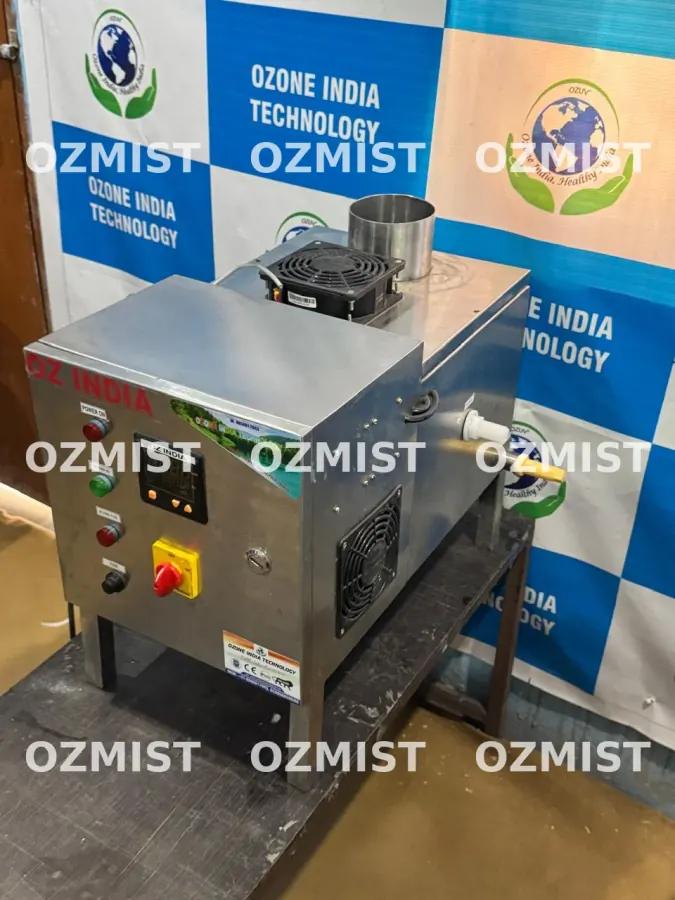
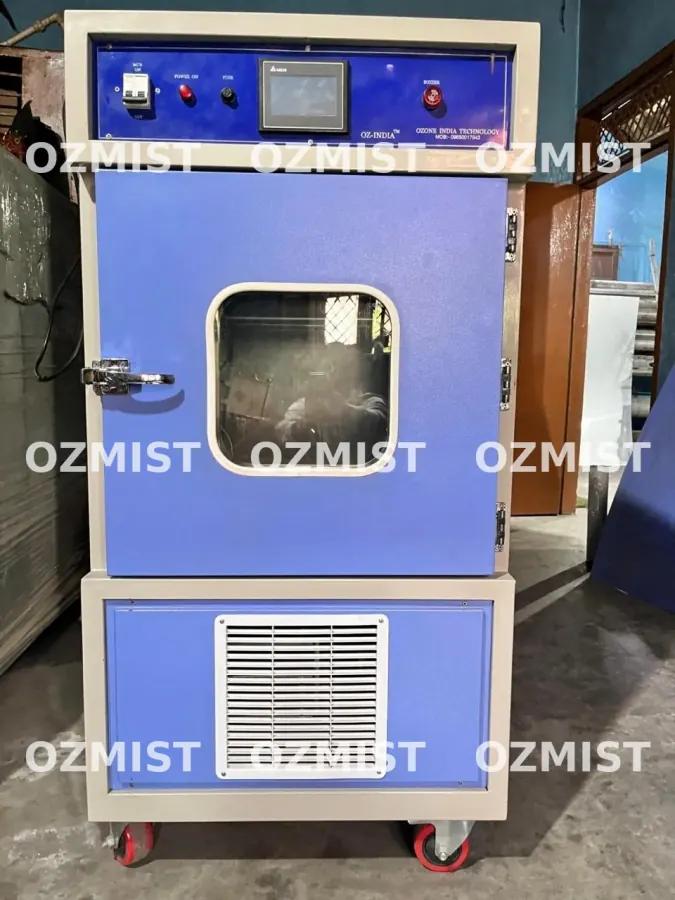
The Ultrasonic Humidifier is deployed across a diverse set of Indian industrial and commercial contexts. What follows is a set of expert application briefs prepared by our engineering team, each describing the operating problem, the applicable Indian and international standards, and how Ozmist's configuration is engineered to meet it.
Every application description references peer-reviewed research or a named regulatory standard so procurement teams, quality engineers, and plant managers can validate the claims against their own audit expectations. Sources are cited in the References section at the end of this page. If your application does not match one of the profiles below, contact our engineering team via the quote form — the majority of custom Ozmist installations begin with a spec conversation rather than a datasheet pick.
Cold Storage and Fresh-Produce Holding Rooms
Cold storage / fresh produce · ASHRAE Refrigeration Handbook
Fresh produce loses weight rapidly under low humidity in cold-storage rooms — a 2–4% weight loss over 7 days at 60% RH translates directly into gross-margin loss for the operator. Cold rooms controlled to 90–95% RH suppress transpiration and can extend saleable shelf life by 5–12 days depending on commodity. Ultrasonic humidifiers work at cold-room temperatures where steam humidifiers waste huge energy re-cooling the humidified air. Ozmist supplies 5, 10, and 20 kg/h models for cold rooms of 50 m³ to 500 m³, with hygrostat control and corrosion-resistant construction for continuous operation in chilled ambient.
Textile Weaving and Spinning
Textile manufacturing · BIS IS 5108
Cotton, polyester, and blended textile mills require 55–70% RH on the shop floor to prevent static electricity, yarn breakage, and fibre fly. The Bureau of Indian Standards recommendation (BIS IS 5108) for textile weaving is 65±5% RH. Under-humidified mills experience 15–30% higher yarn breakage rates on high-speed looms. Ultrasonic humidification is the modern replacement for outdated air-washer humidification because it consumes less power, adds no dust to the environment, and can be precisely modulated to the shop-floor hygrostat. Ozmist supplies mill-floor humidification with distributed heads and central water conditioning.
Printing Presses (Offset and Flexo)
Commercial printing
Paper is hygroscopic: below 45% RH it becomes brittle and shrinks, causing misregistration on multi-colour presses; above 65% it curls and jams the feeder. Print rooms target 50–55% RH with ±3% tolerance. Ultrasonic humidification is standard in high-quality print facilities because the fine mist evaporates completely before landing on paper. Ozmist supplies print shops with in-space humidifiers on the drying floor and in-duct humidifiers in HVAC returns, both controlled from a shop-floor hygrostat with data logging for print-quality traceability.
Pharmaceutical Solid-Dosage Manufacturing (Coating and Tableting)
Pharmaceutical manufacturing · WHO GMP; ICH Q7
Pharmaceutical tablet coating and hard-shell capsule manufacturing require strict humidity control — typically 35–45% RH — to prevent hygroscopic API deliquescence and to control coating film formation. In dry ambient (winter Delhi, summer western India away from coast) supplemental humidification is required. Ultrasonic humidifiers with UV-treated demineralised water feed are compatible with WHO GMP requirements when installed correctly. Ozmist supplies pharma clients with 316L stainless variants and integrates output with the environmental monitoring system (EMS) for 21 CFR Part 11 compliant data logging.
Wooden Furniture, Musical Instrument, and Cigar Storage
Specialty manufacturing / storage
Wood is dimensionally responsive to humidity — below 40% RH solid wood cracks and warps; above 65% RH glue joints weaken and mould can develop. Fine furniture manufacturing floors, musical instrument workshops (guitars, violins, pianos), and cigar humidor rooms require tightly-controlled RH (typically 45–55%). Ultrasonic humidifiers provide the fine control and hygienic operation these premium applications demand. Ozmist has installed humidifiers in cigar humidor rooms, luthier workshops, and furniture manufacturing plants across the Delhi NCR region.
Data Centre and Electronics Assembly Rooms
Data centres / electronics · ANSI/ESD S20.20
Data centres and electronics assembly floors require 40–55% RH to control electrostatic discharge (ESD). Below 40% RH, ESD events increase dramatically — industry data (ANSI/ESD S20.20) shows that ESD-related component failure rates rise 10–30× when relative humidity falls below 30%. Ultrasonic humidifiers are the preferred technology because they add no minerals to the space (protecting sensitive electronics) and can be centrally managed. Ozmist supplies data-centre operators with DM-water humidifiers and Modbus integration into BMS/DCIM.